Gallbladder inflammation (cholecystitis): causes, signs and treatment
Gallbladder inflammation (cholecystitis) is inflammation of the gallbladder wall, and the most common cause is a stone that blocks its outlet. Acute inflammation most often starts with pain in the upper right part of the abdomen that does not ease after several hours, often with fever, nausea and vomiting. It is diagnosed with an examination, an abdominal ultrasound and blood tests. Treatment starts in hospital, and when the cause is a stone, laparoscopic removal of the gallbladder is most often advised. The right time for surgery is decided by the surgeon after the examination.
Signed by: Assist. Prof. Marko Gmijović, MD

What is gallbladder inflammation?
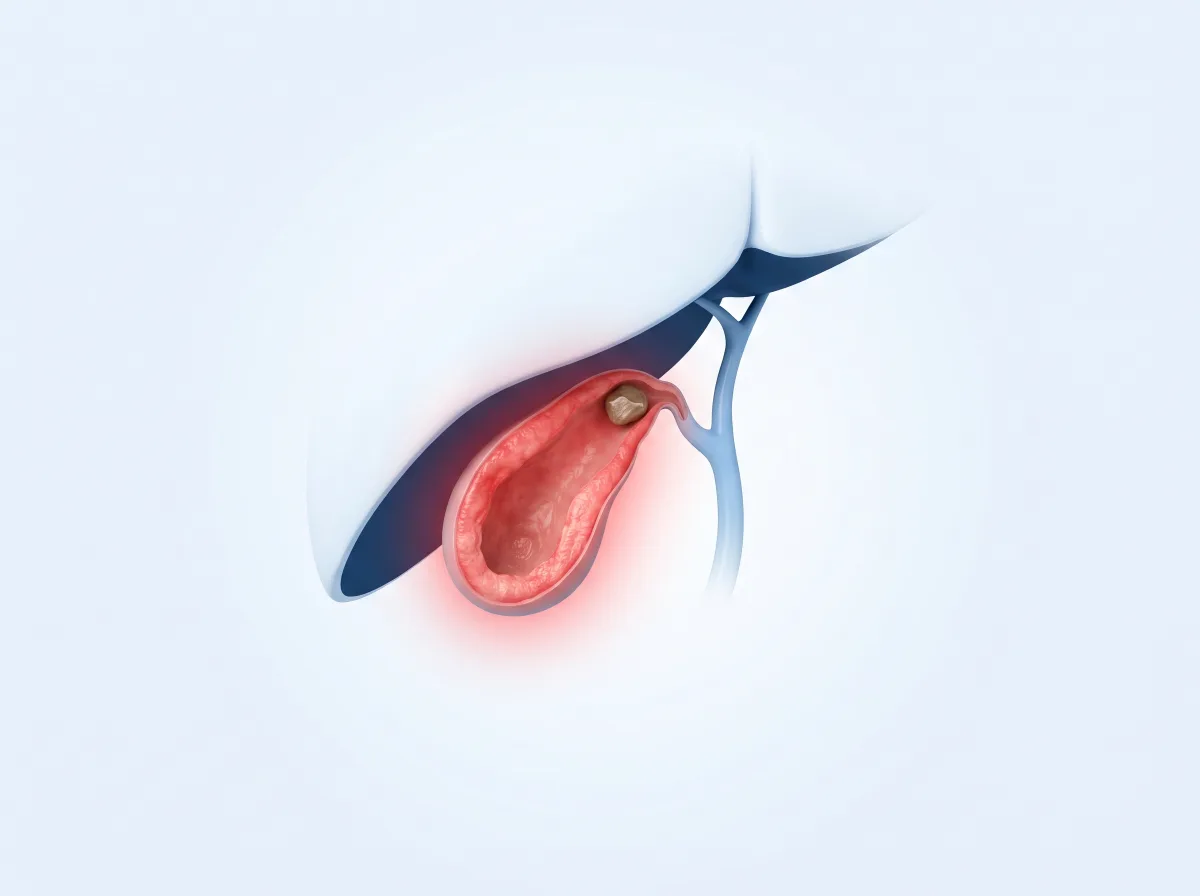
The gallbladder is a small organ under the liver, on the right side of the abdomen. Between meals it stores bile, a fluid made by the liver that helps digest fats. After a meal the gallbladder contracts and pushes bile through a thin duct into the bile ducts and from there into the small intestine.
Gallbladder inflammation, the medical term is cholecystitis, occurs when the gallbladder wall becomes inflamed. The gallbladder then swells, its wall thickens, and the pain is stronger and lasts longer than in an ordinary attack of biliary colic.
There is acute inflammation, which starts suddenly, and chronic inflammation, which develops slowly, after several repeated attacks. Both most often occur in people who have gallstones.
What is the most common cause of gallbladder inflammation?
The most common cause is a gallstone. The stone gets stuck in the outlet of the gallbladder and bile cannot drain. Bile is retained, the gallbladder stretches and its wall becomes inflamed. Later an infection may join the inflammation.
Much less often, inflammation develops without a stone. This most often happens in people who are already being treated in hospital for a serious illness, major surgery or injury.
How gallstones form, who is more prone to them and when a stone without symptoms is only monitored is described in a separate article on gallstones.
Acute gallbladder inflammation: what are the typical signs?
Acute inflammation often starts like an ordinary attack of biliary colic, but the pain does not ease. Typical signs are:
- pain in the upper right part of the abdomen, below the ribs, lasting longer than several hours
- pain that may spread to the back or towards the right shoulder
- pain that gets worse with a deep breath, movement or pressure on that spot
- raised temperature, sometimes with chills
- nausea, vomiting and loss of appetite
In older people and in people with diabetes the signs may be milder, so the inflammation can be missed. Similar complaints can be caused by other conditions, for example diseases of the stomach, pancreas or appendix. That is why complaints alone cannot tell that the gallbladder is the cause. The cause is determined by a doctor, after an examination and test results.
Chronic gallbladder inflammation
Chronic inflammation most often develops after several attacks of biliary colic or milder acute inflammations. The gallbladder wall becomes thickened and scarred, and the gallbladder does not work as it should.
The complaints are usually less severe than in acute inflammation. Most often there are repeated attacks of pain in the upper right part of the abdomen, often after a larger or fattier meal. Some people also describe a feeling of heaviness or bloating after eating, but these complaints can have other causes too.
Chronic inflammation is most often found on an abdominal ultrasound, in people who have gallstones and repeated attacks of pain.
How is gallbladder inflammation diagnosed?
The doctor first talks with you about your complaints and examines your abdomen. In gallbladder inflammation the area below the right rib margin is most often tender to pressure, especially during a deep breath.
The basic examination is an abdominal ultrasound. It is painless, uses no radiation and shows gallstones, a thickened gallbladder wall and signs of inflammation around it.
Blood tests, for example a complete blood count and CRP, show whether there are signs of inflammation. The doctor often also asks for liver tests and bilirubin, to check whether a stone is blocking the flow of bile, and sometimes tests of the pancreas.
When there is a suspicion that a stone has passed into the bile ducts, the doctor may ask for magnetic resonance imaging of the bile ducts (MRCP), and in some cases a CT scan. Which examinations are needed is decided by the doctor. Results are always interpreted by a doctor, together with the complaints and the examination.
How is gallbladder inflammation treated?
Acute gallbladder inflammation is treated in hospital. Treatment most often starts by resting the digestive organs, which means not eating for a while, while fluids and medicines are given into a vein. Painkillers are also given, and antibiotics as the doctor decides.
In some patients the inflammation settles with this treatment. The stone remains in the gallbladder, however, so attacks and inflammation can return. That is why, when the cause is a stone, removal of the gallbladder is most often advised.
In chronic inflammation the treatment is most often planned surgery, after the surgeon's examination and the necessary tests.
Diet, teas and herbal products do not treat gallbladder inflammation and do not dissolve stones. Smaller and less fatty meals make attacks less frequent in some people, but treatment is decided by the doctor.
When is surgery needed and when is it done?
In gallbladder inflammation the whole gallbladder is removed, not only the stone. The operation is most often done laparoscopically, through several small cuts on the abdomen, with a camera and thin instruments. When the laparoscopic approach is not possible or not safe, open surgery is done.
The timing of surgery depends on how long the inflammation has lasted, what the results show and the patient's general health. In some patients the surgeon advises surgery during the same hospital treatment, and in others later, once the inflammation has settled. In chronic inflammation surgery is planned. The right time for surgery is decided by the surgeon after the examination.
Surgery on an inflamed gallbladder can be more demanding and take longer than a planned operation. After planned laparoscopic gallbladder removal the hospital stay is 1 day, as the surgeon assesses. When a more severely inflamed gallbladder is operated on, the stay may be longer, which the surgeon explains before the operation.
What the operation looks like is described on the procedure page, and what to do before it and what recovery looks like in separate articles.
Which signs need an urgent examination?
Untreated gallbladder inflammation can lead to serious complications, such as a pus-filled gallbladder, its rupture and inflammation of the lining of the abdomen. A stone that passes into the bile ducts can cause blocked bile flow, inflammation of the bile ducts or inflammation of the pancreas. So with the following signs do not wait for a scheduled appointment:
- severe pain in the upper abdomen that does not ease even after several hours
- fever, chills or shivering with the pain
- yellowing of the skin or the whites of the eyes
- dark urine or pale stools
- persistent vomiting
For urgent conditions contact Maja Hospital on 018 530 530, as the hospital has emergency surgery. In case of loss of consciousness, difficulty breathing or another serious condition, call the emergency medical service on 194.
What does the surgeon's examination at Maja Hospital look like?
Bring the abdominal ultrasound report, blood tests if you have them, the discharge letter if you were treated in hospital for the inflammation and your earlier medical records to the surgeon's examination. It is useful to write down when the attacks of pain occurred and how long they lasted. Also bring a list of the medicines you take regularly.
The surgeon talks with you about your complaints, examines you and reviews the results. After that the surgeon explains whether and when surgery is needed, and which other examinations are required.
Abdominal ultrasound and magnetic resonance imaging of the bile ducts are done at Maja Radiology, and blood tests in the laboratory. The prices of the surgeon's examination, abdominal ultrasound, basic tests and gallbladder operations are shown in the table below.
The information in this text is general in nature and does not replace an examination by a doctor.