Pancreatitis caused by gallstones: how it develops and how it is treated
Gallstone pancreatitis (biliary pancreatitis) develops when a small stone from the gallbladder passes into the bile ducts and blocks the point where the bile duct and the pancreatic duct drain into the duodenum. The most common sign is severe pain in the upper abdomen, which may spread to the back, together with nausea and vomiting. This condition is treated in hospital. Once the inflammation has settled, the surgeon usually advises removing the gallbladder so that stones do not pass into the ducts again, and the surgeon decides on the timing of the operation.
Signed by: Assist. Prof. Marko Gmijović, MD

How can a gallstone cause inflammation of the pancreas?
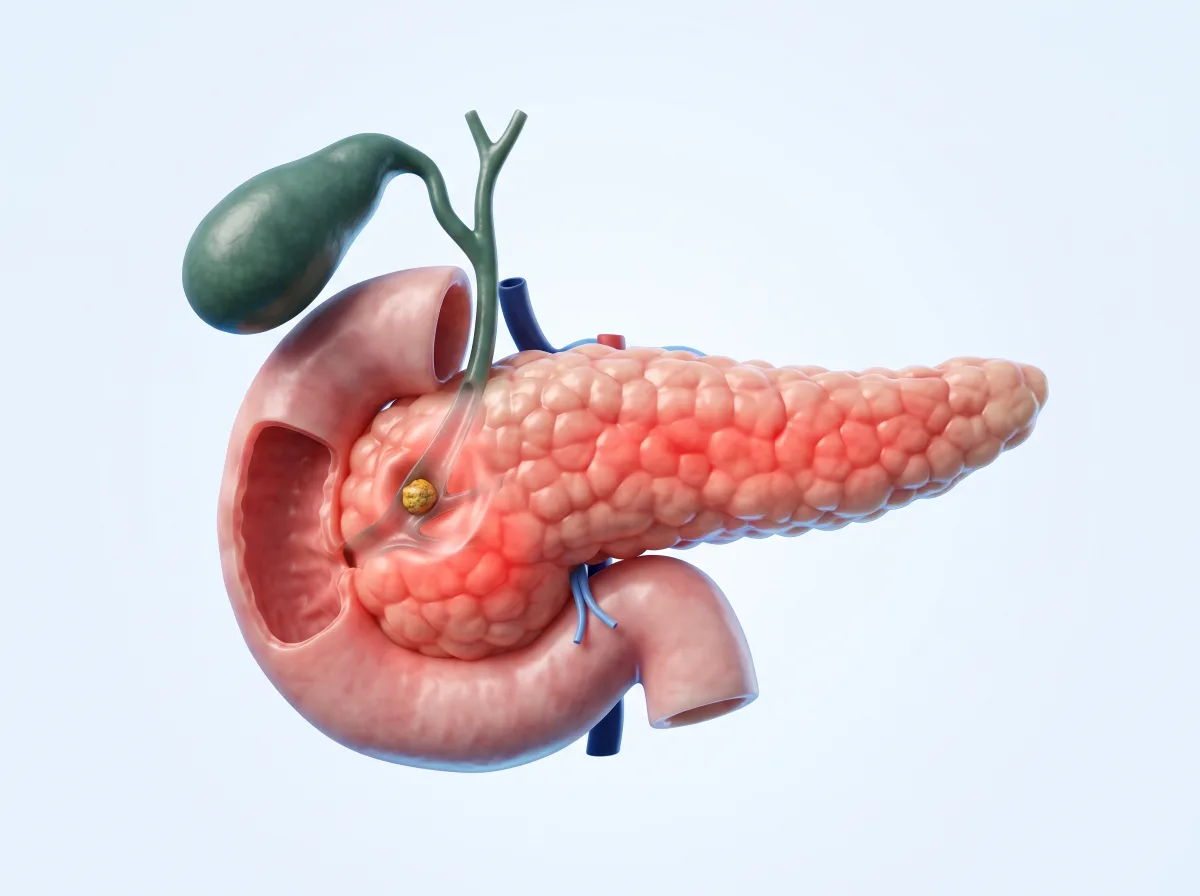
The pancreas is a gland that lies behind the stomach, in the upper abdomen. It produces digestive juices and hormones, including insulin. Pancreatic juices drain through the pancreatic duct into the duodenum.
Bile from the liver and gallbladder drains through the main bile duct. In most people this duct and the pancreatic duct end at the same place, a small opening in the wall of the duodenum.
When a small gallstone slips into the bile ducts, it can get stuck right at this shared outlet. The flow of pancreatic juices then stops, and the pancreas can become inflamed. The medical term is acute biliary pancreatitis. Gallstones are one of the most common causes of acute pancreatitis, together with heavy alcohol drinking.
This is why even small stones can matter. A large stone usually stays in the gallbladder, while a small one passes into the bile ducts more easily. How gallstones form and how they are found is described in a separate article on gallstones.
What are the signs of gallstone pancreatitis?
Pancreatitis usually starts suddenly. The signs most often described are:
- severe pain in the upper abdomen, below the breastbone or slightly to the left or right of the midline
- pain that may spread to the back, like a band
- pain that lasts for hours and does not ease on its own, as ordinary biliary colic does
- nausea and vomiting
- in some people fever, a fast heartbeat or yellowing of the skin and the whites of the eyes
Other conditions can cause similar symptoms, for example inflammation of the gallbladder, a stomach ulcer or heart disease. So symptoms alone cannot show that it is pancreatitis. The cause is established by a doctor, after an examination and test results.
Severe abdominal pain that does not go away is not treated at home and is not a reason to wait for a booked appointment. Where to turn is described in the section on urgent signs below.
How does the doctor make the diagnosis?
The doctor first talks with the patient about the symptoms and examines the abdomen. Blood tests are important for the diagnosis. Raised levels of the pancreatic enzymes amylase and lipase, together with typical pain, point to pancreatitis. Blood tests also show signs of inflammation and whether bile flow is blocked.
An abdominal ultrasound shows whether there are stones in the gallbladder and whether the bile ducts are widened. This is usually how it is established that the inflammation was caused by a stone and not by something else.
When needed, the doctor may also request other imaging, for example a CT scan of the abdomen or a magnetic resonance scan of the bile ducts (MRCP). MRCP shows whether a stone is still in the main bile duct. The doctor decides which tests are needed and when. Results are always interpreted by a doctor, together with the symptoms and the examination.
How is gallstone pancreatitis treated?
Acute pancreatitis is treated in hospital. Treatment is adjusted to how severe the inflammation is and to the patient's general condition, and the plan is set by the doctor.
The basis of treatment usually includes:
- monitoring of the patient's condition and blood tests
- fluids given into a vein
- medicines for pain and nausea
- food that the doctor gradually reintroduces when the condition allows
In most people the inflammation is milder and settles with this treatment. More severe forms may need longer and more intensive treatment.
If a stone is still blocking the main bile duct, or if inflammation of the bile ducts develops along with pancreatitis, the doctor may recommend endoscopic removal of the stone from the duct (ERCP). In this procedure a thin instrument with a camera is passed through the mouth down to the duodenum. Whether ERCP is needed is decided by the doctor in charge of treatment. More about this is in the article on stones in the bile ducts.
Why is the gallbladder removed after the inflammation?
Treatment of pancreatitis calms the inflammation itself, but it does not remove its cause. A gallbladder that has formed stones once stays prone to forming them again, and a new small stone can slip into the bile ducts again and cause another inflammation.
This is why, after gallstone pancreatitis, the surgeon usually advises removing the gallbladder (cholecystectomy). In standard surgical practice the whole gallbladder is removed, not just the stone. The operation is usually done laparoscopically, through a few small cuts, and when that is not possible or not safe, as open surgery.
The operation is not done while the inflammation is active, but once the condition has settled. In milder forms the operation is usually planned soon after the inflammation settles, and in more severe forms later, once the pancreas has recovered. The exact timing is set by the surgeon, based on the course of the illness, test results and the patient's general condition. The patient makes the decision together with the surgeon.
What the operation involves is described on the procedure page, and diet and recovery after it in a separate article.
When to seek help straight away?
Do not wait for a booked appointment if you have:
- severe pain in the upper abdomen that does not go away even after a few hours
- pain spreading to the back, with nausea or vomiting
- persistent vomiting, when you cannot keep even fluids down
- fever, chills or shivering together with the pain
- yellowing of the skin or the whites of the eyes, dark urine or pale stools
For urgent conditions you can contact Maja Hospital on 018 530 530, as Maja Hospital has urgent surgery. In case of loss of consciousness, difficulty breathing or a very serious general condition, call the emergency medical service on 194.
Seeing a surgeon after pancreatitis
After hospital treatment for pancreatitis, the next step is usually an appointment with a surgeon to agree on gallbladder surgery. Bring your hospital discharge letter, blood test results, the abdominal ultrasound report and any other imaging you have, as well as a list of the medicines you take regularly.
The surgeon talks with you about the course of the illness, examines you and reviews the results. The surgeon then explains whether an operation is needed, which method is suitable, which further tests are needed and when the right time for the procedure is.
At Maja Hospital, examinations for gallbladder conditions are done by Assist. Prof. Marko Gmijović, MD, a specialist in general surgery. Abdominal ultrasound and magnetic resonance of the bile ducts are done at Maja Radiology, and blood tests in the laboratory. Information about the examination with the associate professor is on the page Free examination with an associate professor for gallbladder conditions. Prices of the examination, imaging, tests and gallbladder operations are shown in the table below.
The information in this text is general in nature and does not replace an examination by a doctor.