Preparing for an MRI scan: what to wear, what to bring and how long the scan takes
Most MRI scans need no special preparation: you eat, drink and take your medication as usual. The usual exceptions are scans of the abdomen, bile ducts and bowel, and scans with contrast. Wear comfortable clothing without metal and bring your referral or your doctor's recommendation and any previous results. Scanning one area usually takes 20 to 45 minutes. Mention it as soon as you book if you have a pacemaker, an implant or any metal in your body. Appointments at Maja Radiology in Niš can be booked on 018 530 530.
Do you need an empty stomach? Preparation by area being scanned
Magnetic resonance imaging (MRI) produces images of the body using a strong magnetic field and radio waves, without X-rays. Fasting is usually not needed for scans of the head, spine and joints. For scans of the abdominal organs and scans with contrast, preparation is different. You receive exact instructions for your scan when you book, and below is a general overview of what is most often required.
- Head, neck, spine and joints: usually no special preparation. You eat, drink and take your regular medication.
- Pituitary gland: the scan is usually done with contrast, so the preparation for a scan with contrast applies.
- Abdomen and bile ducts (MRCP): you are usually asked not to eat for a few hours before the scan, so that the images of the organs are clearer.
- MRI of the bowel (MR enterography): special preparation, usually with a liquid you drink before the scan, so the whole visit takes longer. You receive instructions when you book.
- Pelvis and prostate: sometimes a certain level of bladder filling or bowel preparation is required, depending on the scan.
- Breasts: if you still have periods, the scan is usually booked between day 7 and day 14 of your cycle, so give the date of your last period when booking. A breast scan is usually done with contrast, and you lie on your front during the scan.
- Heart: electrodes are placed on your chest to monitor your heart, and during the scan you hold your breath briefly several times as instructed. Some heart scans also need additional preparation, and you receive instructions about this when you book.
- Scan with contrast: a recent creatinine result, which shows how well your kidneys are working, is usually required, and sometimes a short period of fasting.
Do not stop your regular medication on your own. If you are not sure whether to take it on the day of the scan, ask when booking or ask your doctor. If you have diabetes and fasting is required for the scan, also ask how to take your diabetes medication that day.
What should you wear for an MRI and what should you leave at home?
Come in comfortable clothing without metal parts, for example a tracksuit or a cotton T-shirt. Metal can be found where you might not expect it: in zips, metal buttons, fasteners, underwired bras and some sports tops with silver threads, which can heat up during the scan. If your clothing contains metal, you will usually change into a hospital gown before the scan.
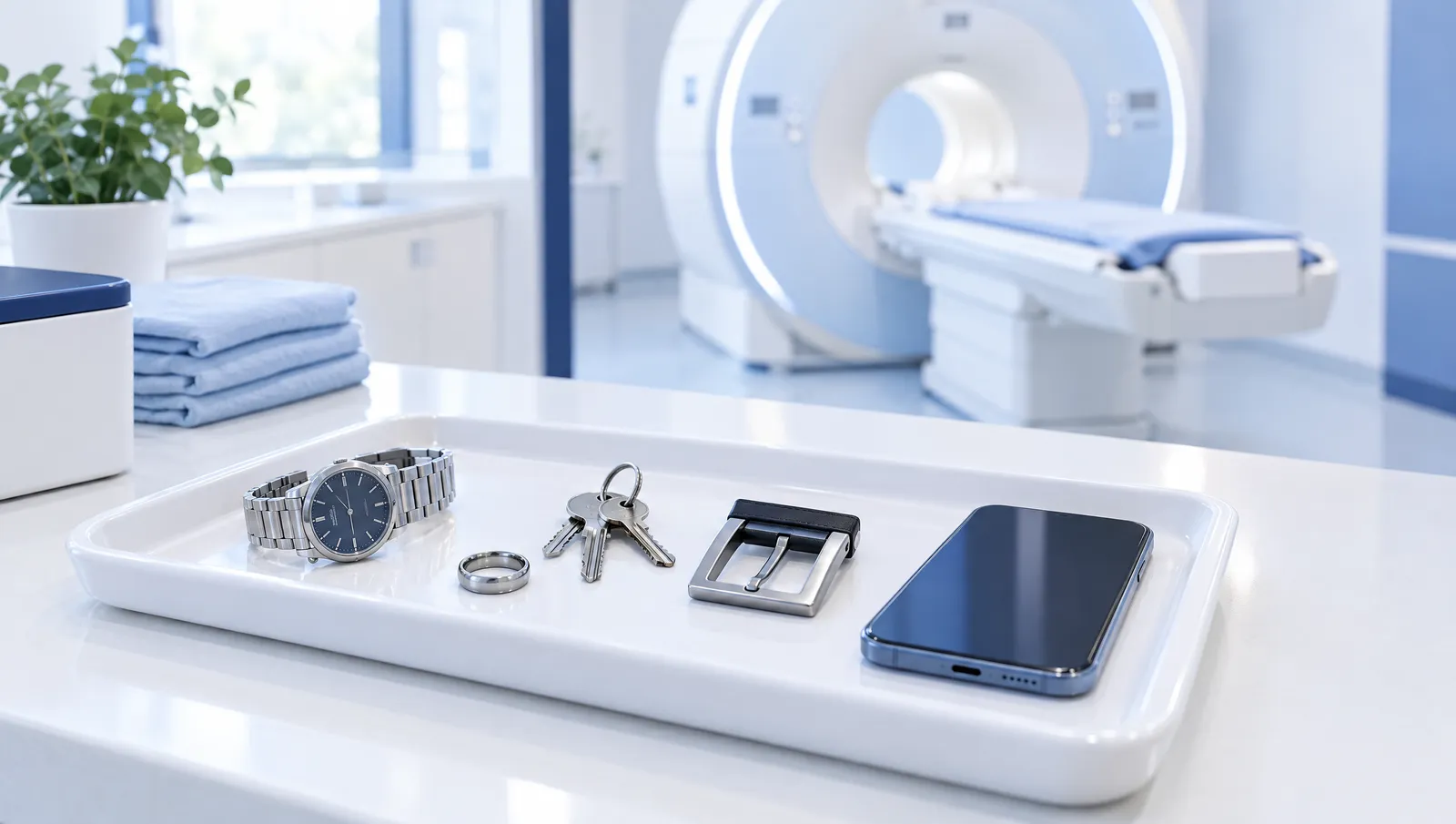
Before entering the scanner room, you remove and leave behind:
- jewellery, watch, rings and piercings
- glasses, hairpins, hair clips and a wig with metal parts
- hearing aid and removable dentures
- phone, keys, wallet and cards (the magnet can erase a card with a magnetic strip)
- belt and anything with a metal buckle
It is best to leave valuables at home. Avoid make-up on your face and around your eyes if your head is being scanned, as some products contain metal particles. Also tell the staff if you have a tattoo, permanent make-up or a medicated patch on your skin. Some patches have a metal layer that can heat up. Do not remove a medicated patch on your own, but ask the staff or the doctor who prescribed it.
Can you have an MRI if you have metal in your body, an implant or dental crowns?
This part of the preparation is important for your safety. Before the scan you fill in a questionnaire, and the radiographer goes through it with you. Mention everything, even if it seems unimportant. The decision on whether the scan is safe is made by the radiologist, based on information about the implant.
Be sure to mention it if you have:
- a pacemaker or an implanted defibrillator
- a cochlear implant, a neurostimulator, a shunt in the head or an implanted drug pump
- an insulin pump, a glucose sensor or another device worn on the body
- metal parts after surgery: clips after surgery on the blood vessels of the brain or other metal clips, an artificial joint, screws, plates, a stent or an artificial heart valve
- a metal fragment or shrapnel in the eye or in the body, for example after metalwork or an injury
- pregnancy or a possibility of pregnancy
A glucose sensor and an insulin pump are usually removed before entering the scanner room, as the magnetic field can damage them. So when booking, ask how to prepare and whether to bring a spare sensor.
Many modern implants and devices are labelled MR conditional. This means the scan can be done only under the conditions set by the manufacturer, for example on a scanner of a certain field strength and with special settings. With pacemakers and defibrillators, a cardiologist usually also needs to adjust the device before and after the scan. This is why the exact model needs to be known. Bring your implant card or the discharge summary from your operation and mention this as soon as you book, as that is when it is checked whether this kind of scan is carried out at Maja Radiology.
Dental crowns, bridges, fillings and dental implants are usually not an obstacle to the scan and stay in your mouth. They can cause a shadow on the images of the face and jaw, so mention them if your head is being scanned. Removable dentures are taken out. Mention fixed braces, a bonded retainer on the inside of your teeth and dentures with magnetic attachments to the staff, as they can cause a shadow on head and neck images.
What should you bring to your MRI scan?
Well-prepared documents help the radiologist focus the scan on the right question and compare the result with earlier ones. Bring:
- your referral or your doctor's recommendation, if you have one
- your ID card or passport
- previous results and images of the same part of the body (CD, USB or printed report)
- discharge summaries and operation reports, especially if you have an implant
- your implant or device card
- a list of the medicines you take and information on allergies, especially if you have reacted to contrast before
- your creatinine result, if this is required for a scan with contrast
If you do not have a creatinine result, ask when booking where and how far in advance to have the blood test. Also ask how early to arrive for the scan, as time is needed for registration and the questionnaire.
How long does an MRI of the head, spine and other areas take?
The scan itself takes less time than the whole visit to the radiology department, as registration, the questionnaire and changing come first. Scanning one area usually takes 20 to 45 minutes. Approximate scan times, not including registration:
- head or pituitary gland: usually 20 to 30 minutes
- one part of the spine (cervical, thoracic or lumbar): usually 20 to 30 minutes
- two parts or the whole spine: usually 40 to 60 minutes
- one joint (knee, shoulder, ankle, elbow): usually 20 to 30 minutes
- breasts: usually 20 to 30 minutes
- abdomen, bile ducts, pelvis or prostate: usually 30 to 45 minutes
- heart, bowel or whole body: usually 45 to 60 minutes, sometimes longer
If contrast is given, the scan takes about ten minutes longer. For an MRI of the bowel, there is also the time needed to drink the liquid before the scan, usually about an hour. The scan may also take longer if part of it has to be repeated because of movement. The exact time depends on the question the scan needs to answer and on the radiologist's assessment.
What happens during an MRI scan?
You lie on a moving table, and the part of the body being scanned is placed in a coil, a special piece of equipment that receives the signal. The table then slides into the opening of the scanner. For scans of the knee or ankle, your head usually stays outside the scanner.
The scanner makes loud knocking, tapping and buzzing noises while it is working. This is the normal sound of the scanner and not a sign that anything is wrong. You are given ear protection, usually earplugs or headphones. The scan does not hurt. It is important to keep still, as even a small movement can blur the image. For scans of the abdomen, you are sometimes asked to hold your breath briefly, as instructed by the radiographer.
The radiographer monitors you from the next room. Before the start, they explain how to get in touch during the scan, and the scan can be stopped if you are finding it difficult. A mild feeling of warmth in the part of the body being scanned is possible and is usually harmless. If you feel strong heat, a burning sensation or pain, for example at the site of a tattoo, tell the radiographer straight away.
If you find it difficult to be in an enclosed space, mention this when booking. You can read more about this in the article on MRI and claustrophobia, and about scans for children in a separate article. Both articles are in the list of related articles at the end of the page.
What happens after the scan and how do you book an appointment in Niš?
After a scan without a sedative, with or without contrast, you can usually return to your normal activities the same day, and you can eat and drive. If you were given a sedative or sedation, do not drive for the next 24 hours, and go home with someone accompanying you.
After contrast, you are sometimes asked to stay briefly in the waiting room for monitoring. On that day you are usually advised to drink more fluids, unless your doctor has restricted your fluid intake. If you notice a rash or itching even a few hours after contrast, contact a doctor. If swelling of the face, lips or tongue or difficulty breathing occurs, call emergency services on 194 straight away.
The images are then reviewed by a specialist radiologist, who writes the report. You will find out when and in what form you can collect the report and images when booking or at registration. Take the report to the doctor who referred you, as they interpret it together with your clinical examination.
MRI scans are carried out at Maja Radiology, at Vizantijski bulevar 39 in Niš, in the Maja Hospital building. Appointments are booked on 018 530 530. When booking, say which part of the body needs to be scanned, whether the doctor has asked for contrast and whether you have an implant or metal in your body. This way you will receive exact instructions for your preparation. Prices of scans by area can be found on the MRI page and in the radiology price list.
The information in this text is general in nature and does not replace an examination by a doctor.