MRI for children: preparation, sedation and having a parent present
An MRI scan for a child does not use X-ray radiation. The scan is painless, but the child has to lie still, usually for 15 to 45 minutes, sometimes longer. Older children can often keep still with good preparation. For young children and children who find it hard to keep still, the doctor may suggest sedation or anaesthesia, with fasting beforehand and continuous monitoring by an anaesthetist. To check whether children's scans are carried out at Maja Radiology in Niš and under what conditions, call 018 530 530.
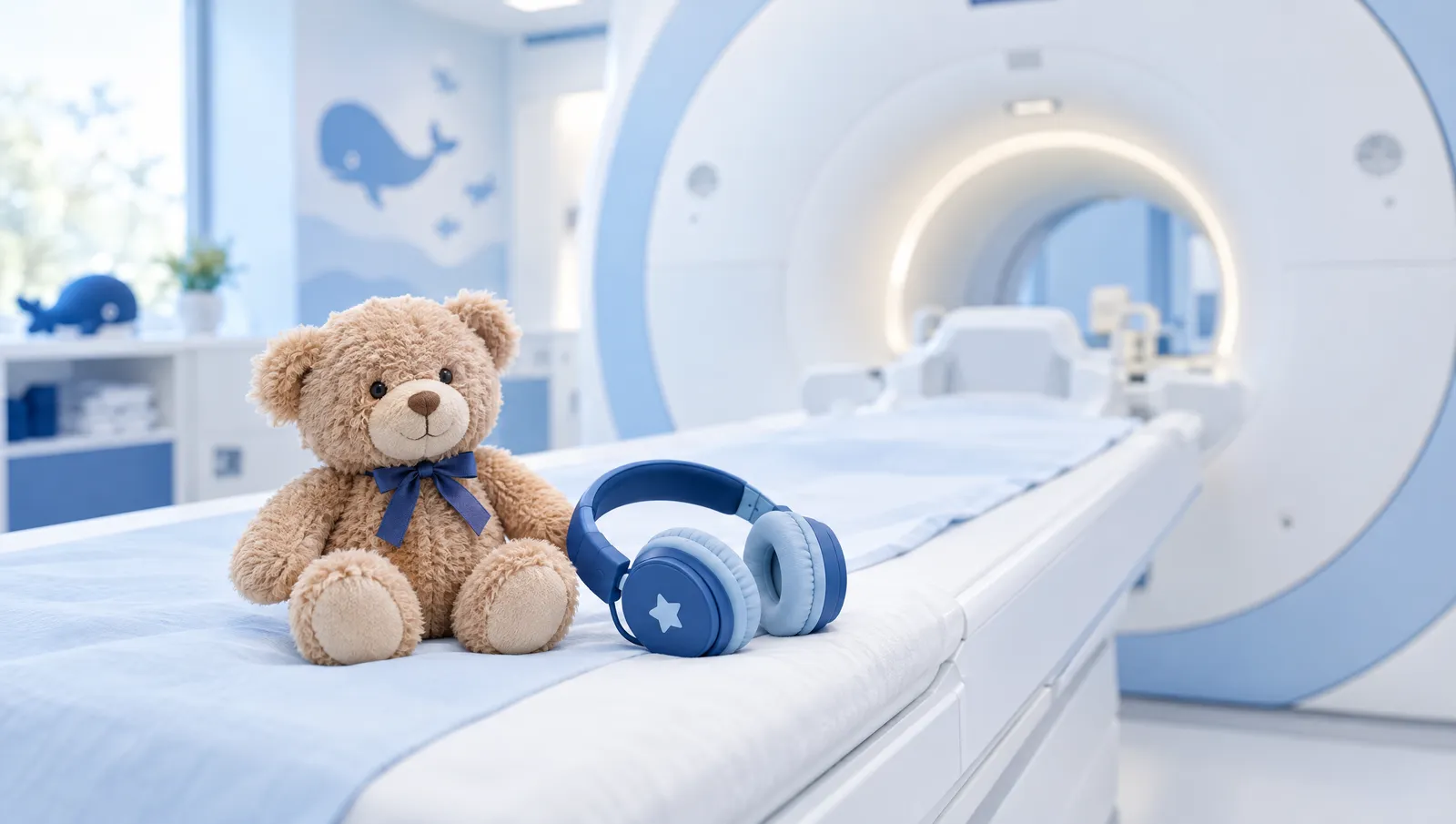
Why does a child have to keep still during an MRI scan?
Magnetic resonance imaging (MRI) produces images using a strong magnetic field and radio waves. The scan itself is painless and does not use X-ray radiation. The child lies on a table that slides into the opening of the scanner, and during the scan the machine makes loud knocking and buzzing sounds. This is why the child is usually given ear protection, earplugs or headphones.
Any movement, even a small one, can blur the images. When this happens, part of the scan often has to be repeated, so the scan takes longer. How long the child needs to keep still depends on the part of the body being scanned, whether contrast is needed and the plan set by the radiologist. It is usually 15 to 45 minutes, and longer for more complex scans.
This is why the main question with children is: can the child lie still for that long? The answer decides whether the scan is done while the child is awake, during natural sleep or under sedation.
When does a child need sedation or anaesthesia?
There is no single age after which sedation is no longer needed. Many school-age children can have the scan while awake, with preparation and support. For babies, young children and children who are unable to cooperate, the doctor is more likely to suggest sedation. With very young babies, a scan during natural sleep after a feed is sometimes attempted, if the doctor considers it possible.
The decision is usually made jointly by the referring doctor, the radiologist and the anaesthetist. They usually consider:
- the child's age and how well they can cooperate
- how long the planned scan will take
- whether the child has a strong fear of enclosed spaces or of the scan
- developmental or other difficulties that make keeping still hard
- the child's general health and any existing conditions
With deep sedation, the child is given medicine that puts them to sleep. The child usually breathes on their own, but the anaesthetist helps keep the airway open and gives oxygen if needed. With general anaesthesia the sleep is even deeper, so the anaesthetist usually places a special mask or small tube that keeps the airway open and helps with breathing if needed. In both cases, an anaesthetist should monitor the child the whole time, from falling asleep to waking up.
The radiology price list includes a separate item for deep sedation during an MRI scan. Whether scans under sedation at Maja Radiology are also carried out for children, from what age and who performs them, please check when booking.
How can you prepare your child for an MRI scan at home?
Children are less frightened when they know what to expect. Tell an older child about the scan a few days beforehand, and a younger child the day before or on the day, calmly and in simple words. Tell the truth: the scan does not hurt, the machine is loud, and it is important to lie as still as a statue. Avoid promises you cannot keep, for example that there will be no needle if contrast or sedation is needed.
A few things usually help:
- playing "statues" at home, so the child can practise lying still on their back
- listening to recordings of MRI sounds, so the noise is not a surprise
- a picture book or drawing that explains what the scanner looks like
- comfortable clothing without metal buttons, zips, sequins or metallic threads, which some sports tops have
- no jewellery, metal hair grips or hair clips
- a favourite toy or small blanket for the waiting room
Nothing metal may be taken into the scanner room. The radiology staff decide whether a toy can go in with the child. When booking, and again before the scan, tell the staff if your child has:
- a shunt (valve) in the head
- a cochlear implant
- a fixed brace on the teeth
- an insulin pump or glucose sensor
- metal parts after surgery or any other metal in the body
Bring the implant card or discharge summary. Many implants allow a scan under certain conditions, and the radiologist decides on this. If your child is particularly afraid of enclosed spaces, you will also find useful tips in the article on MRI and claustrophobia.
What does preparation for sedation involve?
If the scan is done under sedation or anaesthesia, the child must not eat or drink for a set time before the scan. Fasting reduces the risk of stomach contents getting into the airways while the child is asleep. The exact times are set by the anaesthetist and must be followed strictly. Usually the fasting period is longer for food, formula and cow's milk, shorter for breast milk and shorter still for clear fluids such as water. The child can usually drink clear fluids up to one or two hours before the scan, unless the anaesthetist says otherwise. During fasting, the child should not have sweets or chewing gum either.
The child should not go without food for longer than instructed. Long fasting in children can cause thirst, weakness and low blood sugar. If the child does eat or drink something, tell the staff, as the scan is then often rescheduled.
Before sedation, the anaesthetist talks to the parent and examines the child. Tell the anaesthetist:
- whether the child has a cold, cough or temperature, or has been unwell in the past few days
- whether the child snores, has pauses in breathing during sleep or has asthma
- what long-term conditions the child has and what medicines they take regularly
- whether the child has any allergies, especially to medicines, food or latex
- whether the child has had anaesthesia before and how they reacted
- whether anyone in the family has known problems with anaesthesia
After this conversation, the parent or guardian signs the consent form for sedation. The child should take regular medicines only as the anaesthetist advises. For sedation, and sometimes for contrast, the child is usually given a thin plastic cannula in a vein. You can read more about when contrast is given and how it is administered in the article on MRI with contrast.
Who stays with the child during the scan?
A parent is usually with the child during admission, the conversation with the doctor and the preparation. If the child is awake, one parent can usually stay in the room during the scan, next to the table, provided they pass the same safety check as the child. This means the parent also fills in a questionnaire and leaves all metal objects, their phone, cards, keys and watch outside the room. In the room, the parent is usually given ear protection too. A parent who has a pacemaker, an implanted defibrillator, a cochlear implant, an insulin pump or metal in the body, as well as a parent who is pregnant, should tell the staff before going in. In that case it is better for another companion to go in with the child, if possible.
With sedation, the parent usually stays with the child until they fall asleep and then waits outside the room. According to professional guidelines, an anaesthetist then monitors the child the whole time, and the scan is carried out by a radiographer. Breathing, heart rate and blood oxygen levels are monitored continuously during sedation. When the child starts to wake up, the parent usually goes back to be with them.
The rules on parents being present may differ from one scan to another. So when booking, ask whether you can be in the room and up to what point.
What is waking up after sedation like?
After the scan, the child wakes up under supervision. The child goes home only when they are awake, breathing and swallowing normally, and the anaesthetist considers them ready. For the first few hours, the child may be sleepy, unsteady on their feet, tearful or irritable. Some children also feel slightly sick. This usually passes during the day.
First the child is given sips of water, then light food, as the doctor advises. For the rest of the day, the usual advice is:
- the child rests at home, with an adult watching them at all times
- no cycling, scooters, climbing, swimming or unsupervised bathing
- it is advisable to travel home by car, in a child seat suitable for the child's age: one adult drives and another sits next to the child
- the next day the child can usually return to normal activities, if they feel well
Contact a doctor if the child vomits repeatedly or cannot keep fluids down. Also get in touch if the child is unusually sleepy, develops a rash or temperature, if redness and swelling appear where the cannula was, or if anything worries you. When your child is discharged, ask who to call in that case and on which number.
Call an ambulance (194) without delay if the child has difficulty breathing, if their lips turn blue, if you cannot wake them or if they have a seizure.
Report, booking and price
A specialist radiologist reviews the images and writes the report. You will find out when the report will be ready and how to collect it when booking. Take the report to the doctor who referred your child, as they will interpret it together with the child's examination. Bring to the scan:
- a referral or recommendation from the doctor treating your child (check when booking whether a referral is needed)
- previous reports and scans, if you have them
- the implant card or discharge summary, if your child has an implant or has had surgery
- a list of the medicines your child takes
- a change of clothes, nappies if needed and a bottle of water for after the scan
The price of an MRI scan depends on the part of the body being scanned, whether contrast is needed and whether sedation is needed. Current prices are in the radiology price list. Scans are booked at Maja Radiology on 018 530 530. When booking, say how old your child is, what is being scanned and whether the doctor has suggested sedation. General preparation guidance for adults and children is also available in the article on preparing for an MRI scan.
The information in this text is general in nature and does not replace an examination by a doctor.