MRI and claustrophobia: how to prepare for your scan
Claustrophobia, a fear of enclosed spaces, usually does not prevent an MRI scan. It helps when the staff know about the fear in advance, when you know what the scan involves and when you can contact the radiographer during the scan. If this is not enough, the doctor may suggest a sedative to help you relax or a scan under sedation. MRI scans are carried out at Maja Radiology, in the Maja Hospital building at Vizantijski bulevar 39 in Niš. Appointments and preparation are arranged by phone on 018 530 530.
Why does this fear come up with MRI in particular?
Claustrophobia is a fear of enclosed or narrow spaces. During an MRI scan, this feeling can also come on in people who do not usually have it. The reason is simple: you lie still in a narrow space for quite a long time, while the scanner makes loud noises.
This fear is not a sign of weakness and nothing to be ashamed of. Radiographers often come across this fear, so questions about it are routine. If you feel it, say so in good time, because the scan can then be planned better.
What does an MRI scanner look like inside?
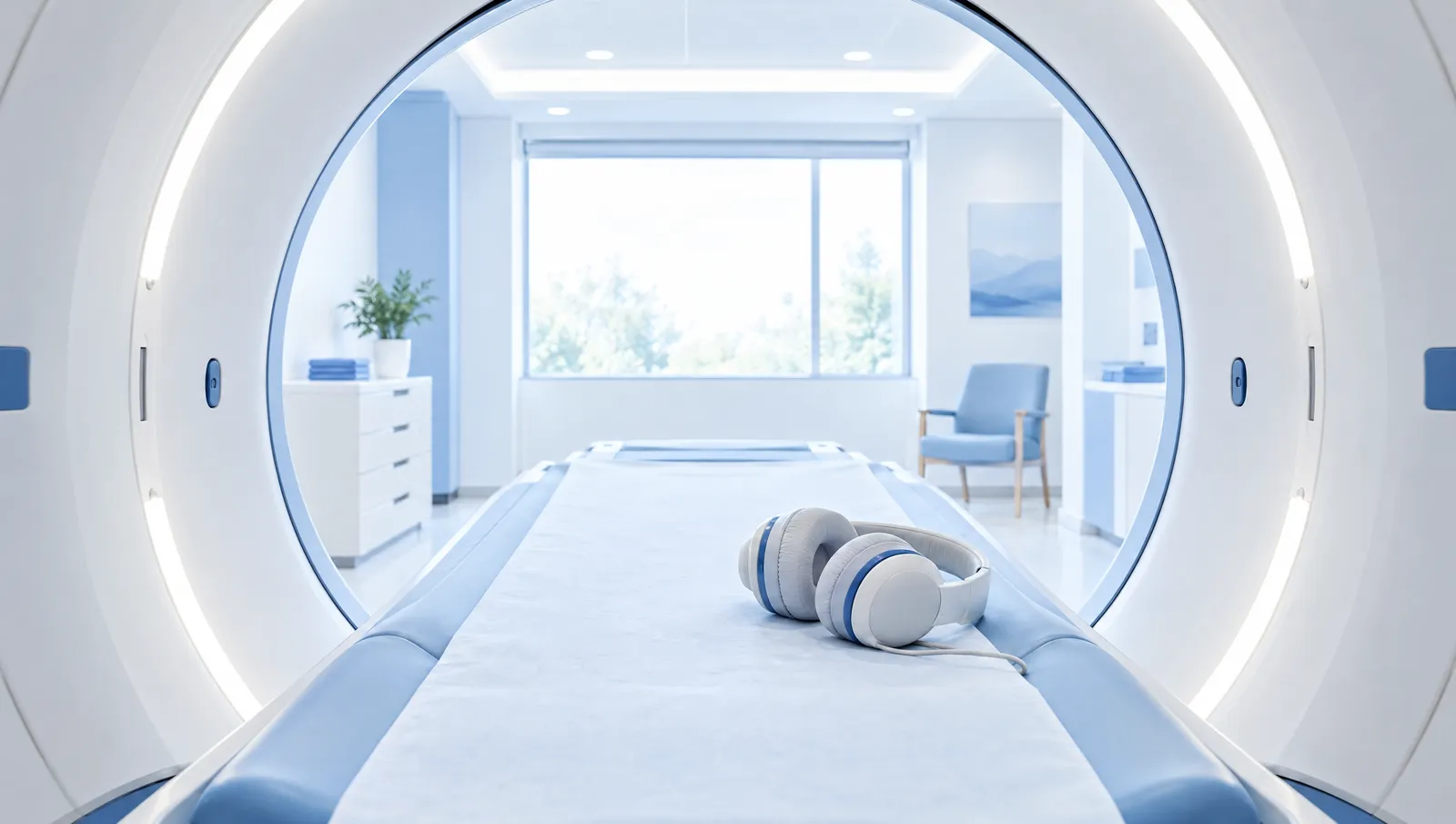
An MRI scanner usually looks like a large ring with a tunnel in the middle. In most tunnel scanners, the tunnel is open at both ends and lit, and air flows through it. You lie on a moving table, which slowly slides into the tunnel. The part of the body being scanned has to be in the middle of the scanner.
For scans of the head and neck, a lightweight plastic coil with openings, similar to a helmet, is placed around your head. It does not press on your face, and you can see out through the openings and breathe normally. For scans of the knee, ankle or foot, you usually go in feet first, so your head stays outside the tunnel or close to its opening. How far you are inside the tunnel depends on the part of the body and the type of scanner.
During the scan, the scanner makes loud knocking and buzzing noises. This is the normal sound of the scanner working and does not mean that anything is wrong. Before the scan you are given ear protection, usually earplugs or headphones. Scanning one area usually takes 20 to 45 minutes. Scans with contrast, scans of several areas and more complex scans take longer, sometimes more than an hour. Ask about the exact length of your scan when you book.
What can you do before the day of the scan?
If you feel afraid of enclosed spaces, what helps most is for the staff to know in advance. Mention it when you book, on 018 530 530, and ask whether an appointment with more time is possible. This gives the staff time to explain how the scan works and to agree with you on what will make the scan easier for you.
- Ask how long your scan takes and how many parts (sequences) it consists of.
- Ask whether you will go in head first or feet first.
- If a previous scan had to be stopped, tell the doctor who is referring you and the staff when you book.
- Arrive about 15 minutes early to check in and fill in the safety questionnaire, so that you are not rushed.
- Wear comfortable clothing without metal parts, and leave jewellery at home.
- Use the toilet before going into the scanner room.
General advice on food, medicines, metal and implants is in the article “Preparing for an MRI scan”, in the related articles section at the bottom of the page.
How do you contact the radiographer during the scan?
Before the scan, the radiographer explains what will happen. Feel free to ask anything you want to know. You can also ask whether, before the scan starts, you can simply lie on the table and get used to the space.
During the scan, the radiographer is usually in the next room. With most scanners, they can see you through a window or on a camera and can talk to you over an intercom. If it helps you to know how much time is left, ask them to tell you before each sequence how long it will take.
Before the scan starts, the radiographer shows you how to let them know if you need them during the scan, usually by pressing a call button or squeezing a rubber call ball. When you do, the radiographer can stop the scan and talk to you. Calling them is not a failure. Sometimes a short pause is enough for you to calm down and carry on.
What helps while you are lying in the scanner?
There is no single tip that helps everyone. Try a few simple things and keep whatever works for you.
- Close your eyes before the table slides into the scanner. Many people find it helps to keep them closed for the whole scan.
- Ask whether you can wear an eye mask.
- Breathe slowly: breathe in through your nose while counting to four, and out through your mouth while counting to six. When the radiographer asks you to hold your breath, for example during scans of the chest and abdomen, follow their instructions.
- Count the sequences or imagine a place where you feel relaxed.
- Ask whether music can be played through headphones during the scan.
- Keep your arms relaxed by your sides. Do not cross your arms or legs or clasp your hands together, unless the radiographer tells you otherwise. If you feel cold, ask for a blanket.
The most important thing is to lie still. Movement makes the images blurred, so part of the scan may have to be repeated. That is why it is better to call the radiographer than to move.
Can someone stay with you?
Having someone close to you there makes the scan easier for many people. In some cases, a companion can be in the scanner room, if they pass the safety check and the staff allow it. They can then sit next to the scanner and hold your hand or foot, depending on how you are lying, so that you know they are there. Ask when you book whether this is possible for your scan at Maja Radiology.
A companion also goes through a safety check before entering, because the scanner's magnetic field is usually on all the time. They must not take metal objects, a phone, keys or bank cards into the room. People with a pacemaker or implanted defibrillator do not enter the room, and for other implants and metal in the body the staff decide after a check. If your companion is pregnant, they should tell the staff before entering. The final decision is made by the radiology staff.
When the patient is a child, you can read about a parent staying with them in the article “MRI for children”, in the related articles section at the bottom of the page.
When does a doctor suggest sedation?
If talking it through, preparation and having a companion with you are not enough, the doctor may suggest a sedative to help you relax, or sedation. This is usually considered when the fear is severe, when a previous scan had to be stopped or when the scan takes longer. The doctor decides on this after assessing your health and the medicines you take.
If the doctor prescribes a mild sedative, you take it before the scan, exactly as instructed. Even after this kind of medicine, do not drive: come to the scan and go home with someone to accompany you. Sedation during the scan is different: the medicine is given where the scan takes place, usually into a vein, and you are monitored throughout by a doctor, usually an anaesthetist. Do not make your own decisions about medicines before the scan and do not take medicines prescribed for someone else. Ask when you book on 018 530 530 whether scans under sedation are also done for adults at Maja Radiology, and under what conditions.
If sedation has been arranged, the following usually applies:
- You do not eat or drink for a set time before the scan, following the instructions you are given.
- You come with someone who will take you home.
- For at least 24 hours, you do not drive, operate machinery, drink alcohol or sign important documents. The exact period is set by the doctor in charge of the sedation.
- After the scan, you stay under observation until you are awake and the doctor decides that you can go home.
What if the scan has to be stopped?
Sometimes a scan does not work at the first attempt. This is not a failure on anyone's part and nothing to be ashamed of. You agree the next step with the doctor who referred you: a new appointment with different preparation, a scan under sedation or, when it is medically justified, a different imaging method.
A CT scan (MSCT) takes less time and the scanner is usually more open, but it uses X-rays and does not always give the same information as an MRI scan. The doctor decides whether this alternative is possible. To book an appointment or ask about preparation or sedation, call Maja Radiology on 018 530 530.
The information in this text is general in nature and does not replace an examination by a doctor.