MRI scan (magnetic resonance imaging) in Niš
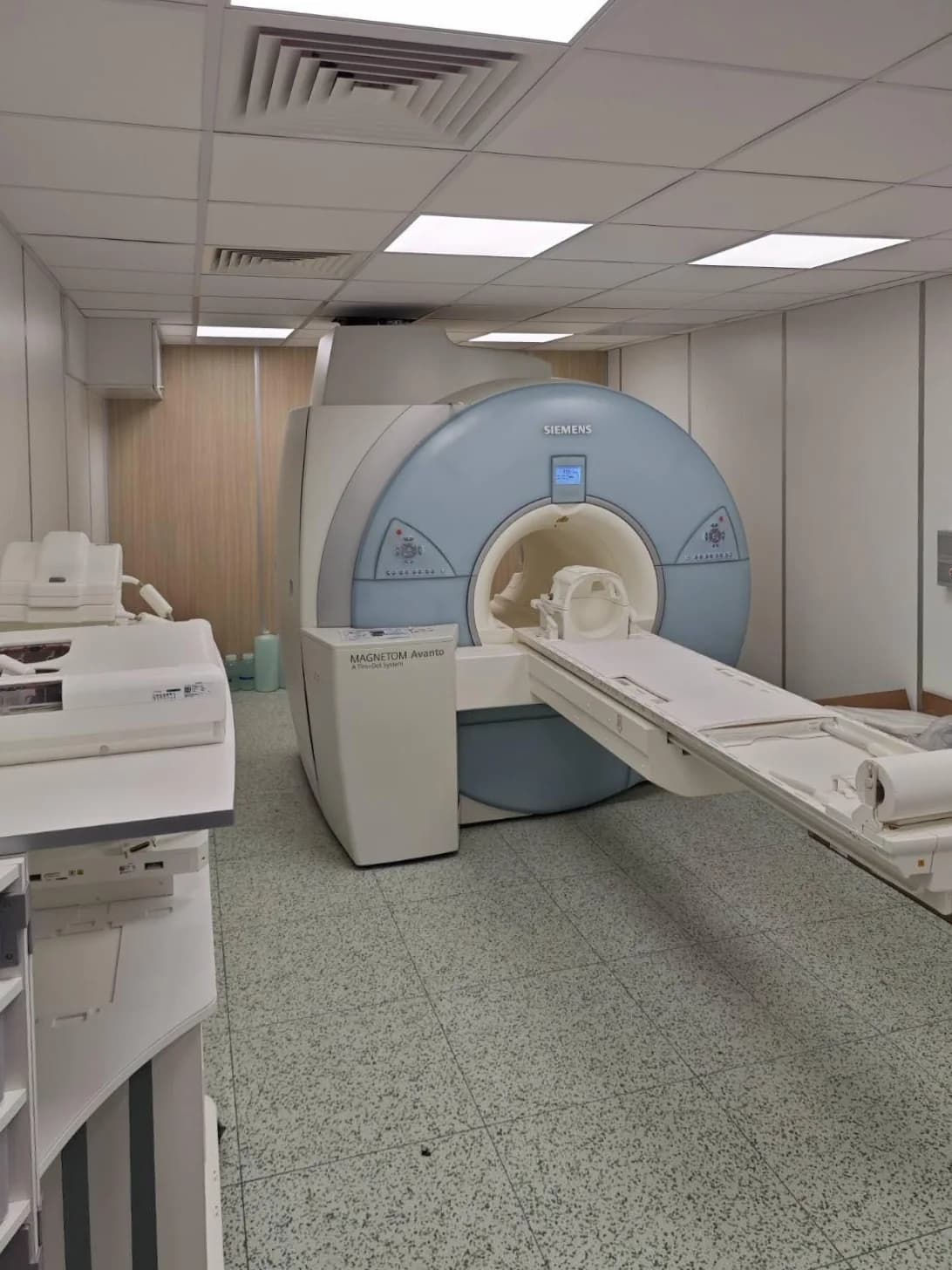
MRI (magnetic resonance imaging) scans are carried out at Maja Radiology, at Vizantijski bulevar 39 in Niš, in the Maja Hospital building.
At a glance
Facts and description
An MRI scan uses a strong magnetic field and radio waves to produce detailed images of the brain, spine, joints, soft tissues and internal organs, without X-ray radiation. Scanning one area of the body usually takes 20 to 45 minutes, and no anaesthetic is needed. The report is written by a specialist radiologist. Prices for the scans are shown in the table on this page, and appointments are booked by phone on 018 530 530.
All facts
- Type of test
- Diagnostic imaging using a magnetic field and radio waves, without X-ray radiation. Carried out on an outpatient basis.
- Price
- Depends on the area being scanned. Contrast, preparation for contrast and sedation are charged separately, as shown in the price table on this page.
- Anaesthetic
- Not needed. For people who cannot keep still during the scan, the doctor may suggest a scan under sedation. Please check when booking whether, and under what conditions, this is done at Maja Radiology.
- Scan time
- Usually 20 to 45 minutes per area. More complex scans take longer, sometimes more than an hour.
- Contrast
- Only when recommended by the doctor. It is given into a vein, and kidney function is usually checked beforehand with a creatinine blood test.
- Hospital stay
- Not needed; you go home after the scan. After sedation, you stay under observation for a short time.
- Return to normal activities
- Usually the same day. After sedation, no driving, operating machinery or alcohol for the next 24 hours, and you go home with someone to accompany you.
- Preparation
- Most scans need no special preparation. For abdominal scans, MRCP, enterography and scans under sedation, you usually need to fast beforehand, and for enterography you drink a special liquid before the scan, so your visit takes longer.
- Report
- Written by a specialist radiologist. When you book, you will be told when and how to collect the report.
- Booking
- By phone on 018 530 530. Maja Radiology, Vizantijski bulevar 39, Niš.
- Note
- This information is general and approximate. The doctor decides on the type of scan, contrast, sedation and preparation.
MRI scan (magnetic resonance imaging): prices
Recovery
- After a scan without contrast and without sedation, you can usually return to your normal activities the same day.
- After sedation, you stay under observation until you are fully awake. For the next 24 hours, do not drive, operate machinery or drink alcohol. Go home with someone to accompany you and follow the anaesthetist's instructions.
- According to the recommendations of professional radiology associations, breastfeeding usually does not need to be interrupted after MRI contrast. If you are unsure, talk to the radiologist before the scan.
- Take the report and images to the doctor who referred you. They will interpret the report together with the clinical examination and agree the next steps with you.
How to prepare
- Bring your referral or doctor's recommendation and any previous reports and images of the same area.
- Tell us about a pacemaker, implant or any metal in your body, and bring your implant card.
- For a scan with contrast, bring a recent creatinine result.
- For an MRI of the abdomen, MRCP, enterography and scans under sedation, come having fasted.
Show 2 more: How to prepare
- For breast MRI, the scan is usually booked between day 7 and day 14 of your cycle, so give the date of your last period.
- Wear clothing without metal and arrive about 15 minutes early to check in and fill in the questionnaire.
When to contact a doctor right away
- After contrast, you are advised to drink more fluids during the day, unless your doctor has restricted your fluid intake. If you notice a rash or itching, contact a doctor. If you develop swelling of the face, lips or tongue, or difficulty breathing, call an ambulance on 194 straight away.
In detail
What is an MRI scan?
Magnetic resonance imaging (MRI, sometimes called MR) is a diagnostic test that uses a strong magnetic field and radio waves to produce detailed images of the inside of the body. A computer uses the signals to build cross-sectional images in several planes, so the radiologist can examine the tissue layer by layer.
MRI does not use X-rays (ionising radiation). It is particularly good at showing soft tissues: the brain, spinal cord, discs and nerves, muscles, tendons, ligaments and cartilage, as well as the organs of the abdomen and pelvis.
You lie on a moving table that slides into the scanner. A coil, the part of the scanner that receives the signal, is placed over the area being scanned. The scan is painless, but the scanner makes loud knocking and buzzing noises while it is working. This noise is expected and does not mean that anything is wrong, and you are given ear protection because of it.
When does a doctor recommend an MRI scan?
You are usually referred for an MRI scan by your GP (family doctor) or a specialist, when an ultrasound or X-ray does not give enough information for a diagnosis or for monitoring. The areas most often scanned are the head, spine, joints, the organs of the abdomen and pelvis, the breasts, prostate, heart and the blood vessels of the head and neck.
MRI is also used for follow-up after treatment or surgery, when the doctor wants to compare images over time. Unlike a CT scan (MSCT), MRI does not use X-rays, but the scan takes longer. The doctor decides which scan is right for you, based on a clinical examination and previous results.
Which MRI scans are available at Maja Radiology?
According to the radiology price list, the following MRI scans are carried out at Maja Radiology:
- Head and neck: brain, pituitary gland, orbits (eye sockets), paranasal sinuses, soft tissues of the neck, MR angiography of the blood vessels of the head and neck, and a brain scan combined with head and neck angiography, with or without venography
- Spine and nerves: cervical (neck), thoracic (upper and middle back) and lumbosacral (lower back) spine, two spinal segments, the whole spine, brachial plexus (the network of nerves supplying the shoulder and arm)
- Joints and limbs: shoulder, elbow, wrist, hand, hips, thigh, knee, lower leg, ankle, foot
- Abdomen and pelvis: abdomen, MRCP (bile ducts), MR enterography (bowel), MR urography (urinary tract), pelvis with targeted images, prostate
- Breasts and heart: breast MRI and cardiac MRI
- Whole-body MRI. This scan is usually done on a doctor's recommendation, for specific conditions. Professional radiology associations do not recommend whole-body MRI as a screening test for people who have no symptoms and no increased risk.
Prices for the scans and additional items are shown in the table on this page. The radiologist decides which scanning protocol is needed.
A scan with or without contrast?
Many MRI scans are done without contrast. For some scans, the radiologist recommends a contrast agent, because it makes blood vessels, areas of inflammation and certain tissues show up more clearly.
The contrast is given into a vein in your arm through a thin plastic tube (cannula), usually during the second part of the scan. Some people feel a brief cold sensation where the needle went in, and less often mild nausea, a headache or a metallic taste. Allergic reactions to MRI contrast agents are rare, and you are monitored by staff throughout the scan.
Before a scan with contrast, kidney function is usually checked with a creatinine blood test. Tell the staff in advance if you have had a reaction to contrast before, if you have asthma or severe allergies, if you have kidney disease, or if you are pregnant or breastfeeding. The doctor decides whether contrast is used.
MRI under sedation and MRI for children
For clear images, you need to keep still throughout the scan. For people who cannot lie still for long, and generally also for young children, the doctor may suggest a scan under sedation. Deep sedation is usually given and monitored by an anaesthetist.
A scan under sedation needs special preparation: fasting as instructed, coming with someone to accompany you and a short stay under observation after the scan. The radiology price list includes a separate item for deep sedation during an MRI scan. Please check when booking on 018 530 530 whether scans under sedation are also done for children, from what age and under what conditions.
What happens on the day of the scan?
This is what an MRI scan usually involves, step by step:
- You come to Vizantijski bulevar 39 in Niš and check in at reception.
- You fill in a short safety questionnaire: implants, previous operations, metal in the body, pregnancy, allergies.
- You leave metal objects, your phone and bank cards outside the scanner room and, if needed, change your clothes.
- If contrast is planned, a cannula is placed in a vein in your arm.
- You lie on the table, usually on your back. A coil is placed over the area being scanned and you are given ear protection. Before the scan starts, the radiographer explains how to let them know if you need anything during the scan.
- It is important to keep still during the scan. The radiographer monitors the scan from the next room.
- After a scan without sedation you go home, and after sedation you stay under observation for a short time. A specialist radiologist reviews the images and writes the report.
Metal, implants and safety
The scanner's magnetic field is usually on all the time, so nothing metal is taken into the scanner room. Before the scan, you must tell the staff if you have any of the following in or on your body:
- a pacemaker or implanted defibrillator
- a cochlear implant, neurostimulator or a valve (shunt) in the head
- an insulin pump, glucose sensor or any other implanted or external device
- clips from surgery on the blood vessels of the brain or other metal clips, a stent or an artificial heart valve
- an artificial joint, screws, plates, metal fragments (for example in the eye) or shrapnel
Also tell the staff if you are wearing a medicated patch or clothing with metallic threads, for example some sports tops, because they can heat up during the scan.
Many implants allow MRI under certain conditions, but the radiologist decides on the basis of the documentation. So please bring your implant card or hospital discharge summary with details of the device. Tattoos and permanent make-up rarely cause a feeling of warmth; if you feel stinging or warmth during the scan, tell the radiographer. If you are or could be pregnant, say so when booking.
Frequently asked questions
How much does an MRI scan cost in Niš?
The price of an MRI scan at Maja Radiology depends on the area being scanned. Contrast, preparation for a scan with contrast and sedation are charged as separate items. Current prices for all MRI scans are shown in the table on this page and in the radiology price list.
How long does an MRI scan take?
Scanning one area, for example the head or one part of the spine, usually takes 20 to 45 minutes. A scan with contrast, or a scan of several spinal segments, the heart, the bowel or the whole body, takes longer, sometimes more than an hour. Also allow time for checking in and the questionnaire; you will be told the exact length when you book.
Is an MRI scan harmful, and does it involve radiation?
An MRI scan does not use X-rays (ionising radiation) and is considered a safe test for most people. The scan is painless. The main risks come from metal in the body and implanted devices, so a safety questionnaire is completed before every scan, and implants and pregnancy must always be reported.
Do I need a referral for an MRI scan?
Please check whether you need a referral for your scan when booking on 018 530 530. It helps to bring the recommendation from the doctor who is sending you and any previous results, because the radiologist uses them to choose the scanning protocol.
How can I manage an MRI scan if I have claustrophobia (fear of enclosed spaces)?
Mention it when booking and before you go into the scanner room. Before the scan starts, the radiographer explains how to let them know if you need anything during the scan, and the scan can be stopped if you find it difficult. If your fear makes the scan impossible, the doctor may suggest medicine to help you relax before the scan, or a scan under sedation. In that case, do not drive after the scan and come with someone to accompany you.
Show 3 more: Frequently asked questions
Can I have an MRI scan if I have a pacemaker or a metal implant?
It depends on the type of device or implant. Some pacemakers and implants allow MRI under special conditions, while with others the scan is not possible. With pacemakers and defibrillators, a cardiologist usually also needs to adjust the device before and after the scan. Bring your implant card or hospital discharge summary and mention it when booking, when staff will check whether this kind of scan is done at Maja Radiology. The final decision is made by the radiologist.
Can I have an MRI scan during pregnancy?
MRI does not use X-rays, and during pregnancy it is done when the doctor judges that the scan is needed, usually without contrast. Always report a pregnancy or possible pregnancy when booking; the decision is made by the radiologist together with the doctor who is referring you.
When will I get my MRI results?
A specialist radiologist reviews the images and writes the report. When you book, you will be told when and how to collect the report and images. Take the report to the doctor who referred you, because they interpret it together with the clinical examination.
The information in this text is general in nature and does not replace an examination by a doctor.
Book an appointment: MRI scan (magnetic resonance imaging)
Information on this website does not replace a medical examination. Treatment is decided by a doctor after the examination.