CT scan (MSCT) in Niš
An MSCT scan (a CT scan, or multislice computed tomography) is carried out at Maja Radiology, in the Maja Hospital building at Vizantijski bulevar 39 in Niš.
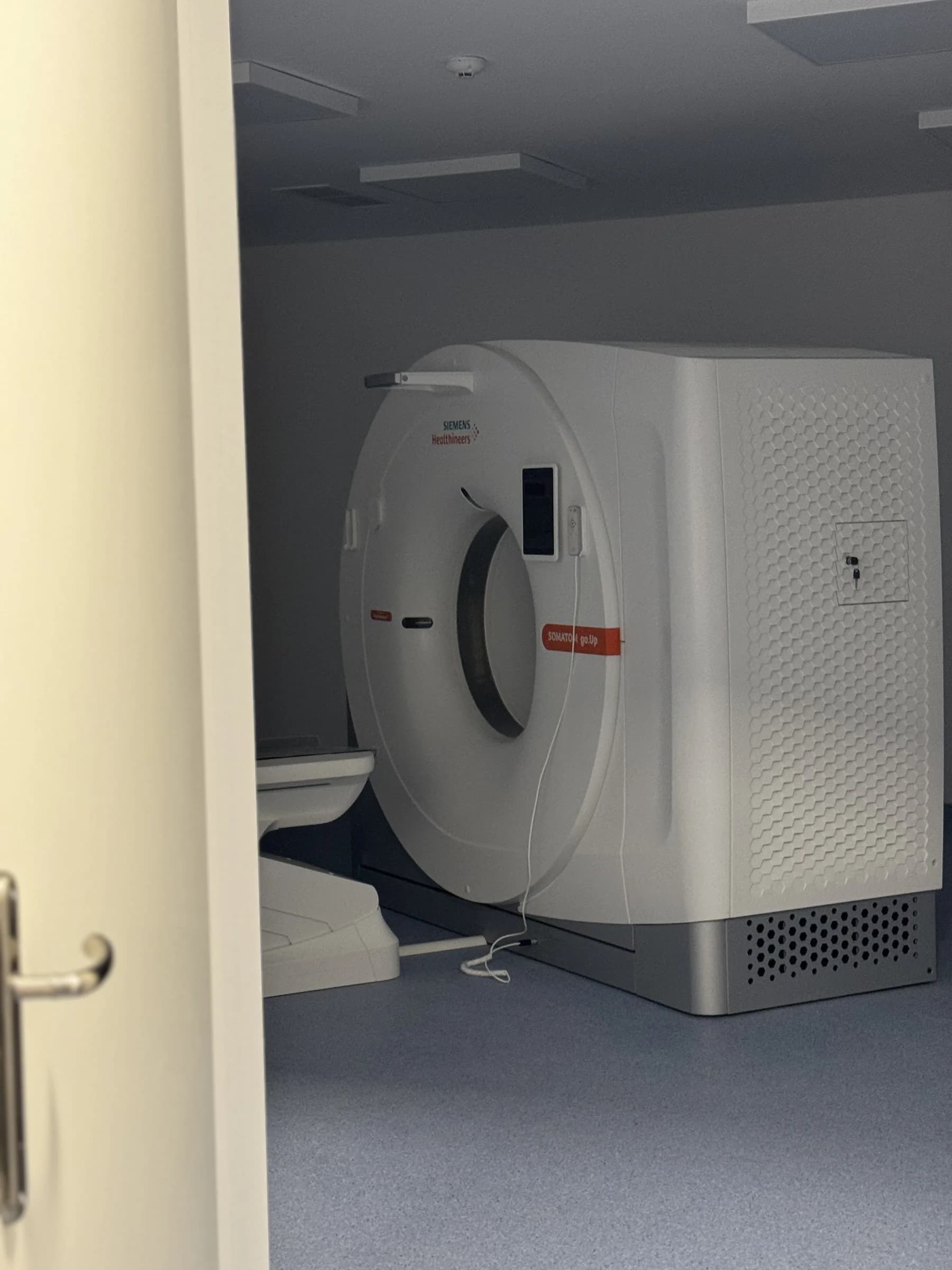
At a glance
Facts and description
The head, neck, chest, abdomen, pelvis, spine, joints and blood vessels can be scanned, with or without contrast. The scan itself usually takes a few minutes and does not require a hospital stay. A specialist radiologist reviews the images and writes the report. Prices for each body region are in the radiology price list, and the scan can be booked on 018 530 530.
All facts
- Type of scan
- Multislice computed tomography (MSCT, CT): imaging with X-rays, processed by a computer
- Anaesthetic
- Usually not needed. The patient is awake and needs to keep still during the scan.
- Length of the scan
- Usually a few minutes. With preparation and contrast, you will be there longer.
- Contrast
- For some scans, given into a vein or by mouth. CT angiography and intravenous urography are done with contrast injected into a vein. For other scans, the radiologist decides.
- Preparation
- Usually none is needed for a scan without contrast. For a scan with contrast, a creatinine blood test result is usually required. Whether you need to come without eating is explained when you book.
- Hospital stay
- Not needed. This is an outpatient scan.
- Return to normal activities
- You can usually go back to your normal activities after the scan.
- Report
- A specialist radiologist reviews the images and writes the report. When you book, you will be told when to expect the report.
- Follow-up appointments
- Not part of the scan. You take the report to the doctor who recommended the scan or to your registered general practitioner (GP).
- Price
- By body region, in the table on this page. You can check what is included in the price of a scan with contrast when you book.
- Booking
- By phone: 018 530 530
- Note
- This information is general and approximate. The type of scan and the preparation are decided by the doctor.
MSCT scan (CT scan): prices
Recovery
- After a scan without contrast, you can usually carry on with your normal activities.
- After a scan with contrast, you usually stay under observation for a short time and then go home.
- Unless your doctor has told you to limit your fluid intake, drink more water that day to help your body clear the contrast.
- The injection site on your arm may be slightly tender for a day or two. If you notice swelling or spreading redness, contact a doctor.
Show 3 more: Recovery
- A mild rash or itching after contrast can also appear a few hours or days later. If this happens, contact a doctor.
- Take the report and images to the doctor who recommended the scan. Any further treatment or follow-up scan is decided by the doctor.
- This is general information. Instructions for your scan are given by the radiologist.
How to prepare
- Bring your referral or doctor's recommendation, an identity document and a list of your medicines, and do not stop any treatment on your own.
- For contrast, bring a recent creatinine result with eGFR, and check how recent it must be when you book.
- If you have diabetes, ask how to fit your meals and medication around your appointment.
- For an abdominal scan with contrast that you drink, arrive considerably earlier, at the agreed time.
Show 2 more: How to prepare
- When booking, tell us if you are pregnant, could be pregnant or are breastfeeding.
- Wear clothing without metal parts and leave jewellery at home.
When to contact a doctor right away
- Swelling of the face, lips or tongue, difficulty breathing or a feeling of choking after contrast is an emergency. Call an ambulance on 194.
In detail
What is an MSCT scan?
MSCT stands for multislice computed tomography. In everyday speech it is called a CT scan, or simply a scan. The scanner uses X-rays and a computer. A tube that produces X-rays rotates around the body, and the computer uses the data it collects to create thin cross-sectional images of the body, similar to slices.
These images can also be used to build three-dimensional views of bones, organs and blood vessels. This is why a CT scan gives a more detailed picture than a standard X-ray. A specialist radiologist reviews the images and writes the report.
When might a doctor recommend a CT scan?
A doctor refers you for an MSCT scan when they need a detailed image of a particular part of the body. The most common reasons are:
- assessment after an injury to the head, spine, bones or joints
- examination of the lungs and other organs in the chest
- examination of the abdominal and pelvic organs, the kidneys and the urinary tract
- imaging of the blood vessels (CT angiography) of the head and neck, lungs, aorta, arms and legs
- examination of the sinuses, eye sockets (orbits) and temporal bones
- assessing how far the disease has spread and monitoring the course of treatment in patients with cancer
- planning surgery and follow-up afterwards
Whether a CT scan is the right choice, or whether an ultrasound, X-ray or MRI scan would be better, is assessed by the doctor, depending on the clinical examination, test results and any previous scans.
This page describes booked scans. Urgent symptoms, such as sudden weakness or numbness on one side of the body, severe chest pain, difficulty breathing or a head injury with loss of consciousness, are dealt with by the emergency ambulance service. In that situation, call 194.
Which MSCT scans are available at Maja Radiology?
According to the radiology price list, the following MSCT scans are carried out at Maja Radiology:
- MSCT of the head (head CT scan), eye sockets (orbits), sinuses (paranasal sinuses) and the bones at the side of the skull (temporal bones)
- MSCT of the neck
- MSCT of the chest and lungs
- MSCT of the abdomen and pelvis
- MSCT of the kidneys and urinary tract, and MSCT urography
- MSCT of the spine: a single segment or the lumbosacral spine (lower back)
- MSCT of the joints: knee, shoulder or another joint
- MSCT angiography (CT angiography) of the blood vessels of the head and neck, the pulmonary arteries, the aorta, the abdominal aorta and the blood vessels of the arms and legs
- oncology assessment of how far the disease has spread, by scanning several regions of the body (in the price list: MSCT oncology staging)
- scanning several regions of the body in a single examination after serious injuries, usually the head, neck, chest, abdomen and pelvis (in the price list: PAN MSCT)
Some scans are done without contrast and some with contrast. CT angiography and intravenous urography are always done with contrast injected into a vein, so the preparation for a contrast scan applies to them. For other scans, the radiologist sets the protocol based on the referral and the clinical question from the doctor who is sending you for the scan.
Scans with contrast: what you need to know
Contrast is an iodine-based liquid that is injected into a vein, usually in the arm. It shows blood vessels and organs more clearly. For some abdominal scans, depending on the protocol, you drink a contrast liquid before the scan.
When the contrast is injected, it is common to feel warmth through the body, a metallic taste in the mouth or a feeling as if you need to pass urine. These sensations are expected and usually pass within a minute or two. Hypersensitivity (allergic) reactions to contrast are rare and usually mild. When they do happen, it is usually soon after the injection, so patients normally stay under observation for a short time after the scan. A mild rash or itching sometimes appears a few hours or days later.
Before a scan with contrast, a blood creatinine result is usually required. It is used to estimate how well your kidneys are working (eGFR), because contrast leaves the body through the kidneys. When you book, tell us whether you have had a reaction to contrast before, whether you have allergies or asthma, kidney disease, thyroid disease or diabetes, and which medicines you take regularly. Also tell us if you are due to have radioactive iodine treatment or a radioactive iodine thyroid scan, because iodine-based contrast can affect that scan or treatment. Based on this, the doctor decides on your preparation.
What happens on the day of the scan?
On the day of the scan, you report to the radiology reception in the building at Vizantijski bulevar 39 in Niš. Before a scan with contrast, you usually fill in a questionnaire and sign a consent form, and a thin plastic cannula is placed in a vein in your arm.
In the scanning room, you lie on a table, usually on your back. The table moves slowly through the wide ring of the scanner. The ring is short and open, so it usually feels less enclosed than the longer tunnel of an MRI scanner. The radiographer monitors the scan from the next room and gives you instructions. Keep still during the scan, and for chest and abdominal scans, hold your breath briefly when you are asked to.
The scan itself usually takes a few minutes. You will be there longer overall if contrast is given, because you usually stay under observation for a short time after the scan. You will be given your arrival time and the expected length of your appointment when you book.
CT or MRI: the main difference
A CT scan uses X-rays, while MRI uses a magnetic field and radio waves, without ionising radiation. A CT scan is a shorter examination and is most often used for the lungs, bones, blood vessels, abdominal organs and assessment after injuries. MRI shows soft tissues in more detail, such as the brain, spinal cord, cartilage and ligaments.
A pacemaker, metal prostheses, screws and plates are usually not a problem for a CT scan. Metal can make the image less clear in the part of the body where it is located, so when you book, tell us what implants or devices you have. Which method you need is decided by the referring doctor, in consultation with the radiologist if needed.
Radiation and safety
A CT scan uses ionising radiation. The dose depends on the part of the body being scanned and on the protocol, and it is higher than for a standard X-ray. The risk from a single scan is small, but it adds up with the number of scans. This is why a scan is done when the doctor judges that the benefit of the result outweighs the possible risk. The dose is adjusted so that it is no higher than needed for a clear image. Children are more sensitive to radiation than adults, so the need for a CT scan is assessed particularly carefully in children.
If you are pregnant or could be pregnant, say so when you book and again before the scan. Repeat scans within a short period are agreed with the doctor, who reviews your previous scans. This is why it is useful to bring your previous reports and scans to the appointment.
Report and price
A specialist radiologist reviews the images and writes the report. You take the report and the images to the doctor who recommended the scan, because they interpret the report together with your clinical examination and other test results. When you book, you will be told how long the report will take and how to collect the images.
The price depends on the region being scanned and on whether contrast is needed. The contrast fee and the preparation for a scan with contrast are listed as separate items in the radiology price list. Check what is included in the price of your scan when you book. Prices of MSCT scans by region are in the table on this page, and all items are in the radiology price list.
Frequently asked questions
Is an MSCT scan the same as a CT scan?
Yes. MSCT (multislice computed tomography) is the examination that is commonly called a CT scan, or simply a scan. The scanner uses X-rays and a computer to create thin cross-sectional images of the body, which can also be used to build three-dimensional views. Multislice means that the scanner captures several slices in a single rotation, so the scan is quick.
How long does a CT scan take, and does it hurt?
The scan itself usually takes a few minutes and does not hurt. For a scan with contrast, you feel a needle prick when the cannula is placed in a vein, and during the injection you will often feel warmth through the body or a metallic taste in the mouth, which usually pass within a minute or two. Because of the preparation and the short period of observation after contrast, you will be there longer. You will be given the expected length of your appointment when you book.
Is a CT scan harmful because of the radiation?
A CT scan uses ionising radiation, but the risk from a single scan is small. The risk adds up with the number of scans and is higher in children. The dose depends on the region and the protocol, and it is higher than for a standard X-ray. This is why a scan is done when the doctor judges that the benefit of the result outweighs the possible risk. Agree any repeat scans with your doctor, who will review your earlier scans. Always tell us before the scan if you are pregnant or could be pregnant.
How do I prepare for a CT scan with contrast, and do I need to fast?
For scans without contrast, fasting is usually not needed. For a scan with contrast, a blood creatinine result is usually needed, because contrast leaves the body through the kidneys. Whether you need to skip a meal, and for how many hours, is explained when you book, and you can usually drink water. Also tell us whether you have had a reaction to contrast before, and whether you have allergies or asthma, kidney disease, thyroid disease or diabetes. Do not stop your regular medication without talking to your doctor first.
Do I need a referral for an MSCT scan?
A CT scan uses radiation, so it is done when a doctor judges that it is needed. For this reason, a referral or a doctor's recommendation is usually required. Whether you need a referral for your chosen scan, and which referrals are accepted, is explained when you book on 018 530 530. A recommendation helps the radiologist know what needs to be checked and choose the right protocol. Also bring your previous reports and earlier scans, for comparison.
Show 3 more: Frequently asked questions
Can pregnant or breastfeeding women have a CT scan?
During pregnancy, a CT scan is done only when the doctor judges it essential, and when possible, a method without radiation is chosen. This is why you should always tell us when you book if you are pregnant or could be pregnant. If you are breastfeeding, mention this when you book as well. According to European professional guidelines, breastfeeding can usually continue as normal after iodine-based contrast, and you can ask the radiologist any questions you have about this.
When will I get my CT scan report?
A specialist radiologist reviews the images and writes the report, and when you book, you will be told how long the report will take. Take the report and images to the doctor who recommended the scan, because they decide on the next steps.
How much does an MSCT scan cost in Niš?
The price of an MSCT scan at Maja Radiology depends on the region being scanned and on whether contrast is needed. The contrast fee and the preparation for a scan with contrast are listed as separate items in the price list, and you can check what is included in the price of your scan when you book. Current prices of all MSCT scans are in the radiology price list at bolnicamaja.rs/cenovnik/radiologija/, and the scan can be booked on 018 530 530.
The information in this text is general in nature and does not replace an examination by a doctor.
Book an appointment: MSCT scan (CT scan)
Information on this website does not replace a medical examination. Treatment is decided by a doctor after the examination.